
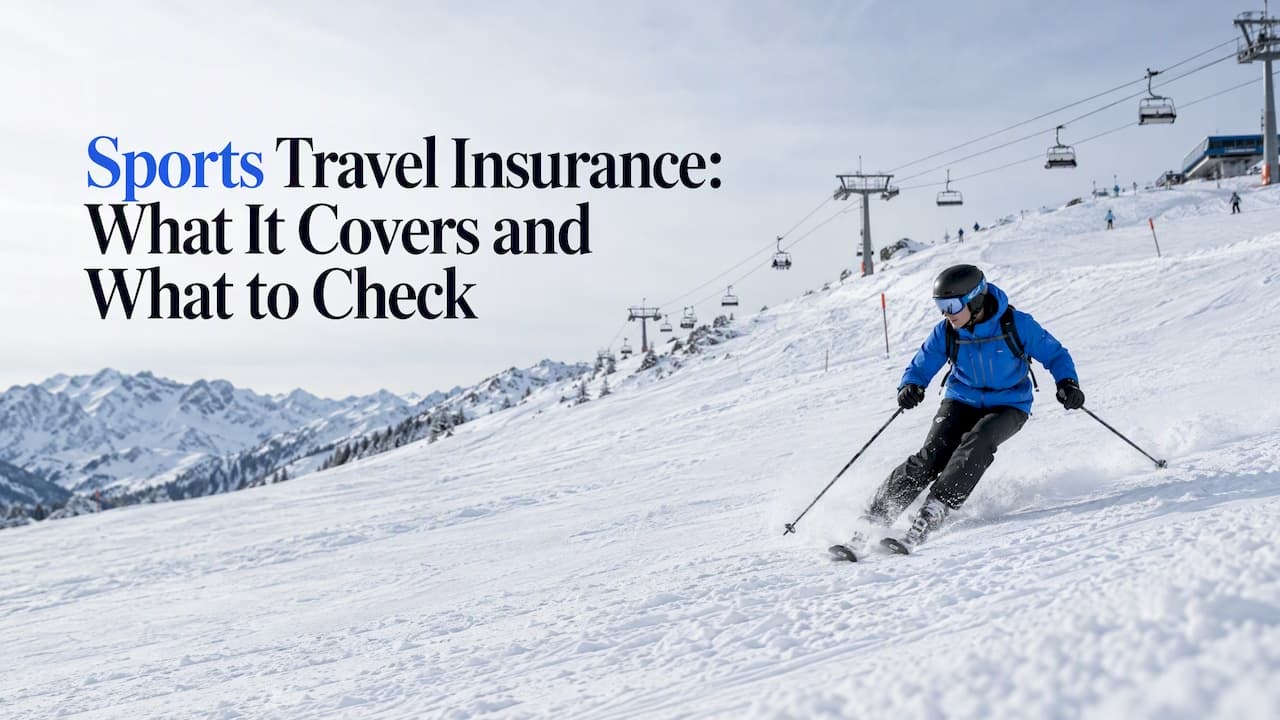
Sports travel insurance is travel insurance that explicitly covers the activity you are going abroad to do, whether that is skiing, scuba diving, mountain biking or a marathon. A standard policy often leaves those activities out. Coverage usually comes as an optional add-on or as a specialist policy, and the only reliable way to know is to match the policy's activity list against your itinerary before you pay.
This guide explains how sports cover differs from a standard plan, which activities tend to need extra cover, what is commonly excluded, what drives the price, and a checklist you can use on any policy.
TL;DR
- Most standard travel policies do not include adventure sports. Cover is usually an optional extra, and some activities need a specialist policy.
- Winter sports, scuba diving and mountain biking are the activities most likely to need separate or upgraded cover. Rules differ by insurer.
- Claims are commonly denied for illegal activities, ignored safety instructions, alcohol or drugs, and travel to places under a "do not travel" advisory.
- Even with insurance you may have to pay for rescue or evacuation upfront. Medical evacuation to the US can run from $20,000 to $200,000.
- Read the activity list and the definitions in the policy wording. Do not rely on the marketing page.
Table of Contents
- What sports travel insurance is, and how it differs from a standard plan
- Which sports usually need extra cover
- What sports travel insurance can cover
- What is commonly excluded
- What affects the price
- How to check a policy before you buy
- Worked example: a week of skiing with a non-skiing day
- Our perspective
- Compare before you commit
- Before you leave
- FAQ
- Sources
What sports travel insurance is, and how it differs from a standard plan
A standard travel policy bundles a few protections: emergency medical care, trip cancellation or interruption, delayed or lost baggage, and sometimes emergency evacuation. Sports travel insurance uses the same building blocks but changes one thing: it names the sports that are covered, so a claim arising from them is not rejected as a "hazardous activity."
The Australian government's travel advisory service says that most travel insurance policies do not include adventure activities and sports, that they are usually an optional extra, and that you may need a specialised policy. Canada's government gives similar guidance: a standard plan may not offer adequate coverage for extreme sports, nature expeditions or other adventure activities.

That is why the same keyword shows up under many names: sports trip insurance, adventure sports cover, extreme sports add-on, hazardous sports rider. They all describe the same gap, a policy that works for a beach holiday but not for the glacier hike you booked.
Three ways the cover is built
| Structure | How it works | Best for |
|---|---|---|
| Activity add-on or rider | You buy a base travel policy and add a sports or adventure upgrade | A trip with one or two higher-risk activities |
| Higher plan tier | The insurer's upper tiers include a longer list of sports | Travelers who want several activities without itemizing each |
| Specialist sports policy | A policy designed around a sport or group of sports, sometimes with equipment cover | Frequent participants, competitors, and high-risk activities |
None of these is automatically better. A rider on a good base policy can beat a cheap specialist policy with a short benefit limit. What matters is whether your exact activity, in your exact destination, at your exact level, is named in the wording.
Which sports usually need extra cover
Insurers sort activities into rough risk bands, and the band decides whether you are covered automatically, need an add-on, or are excluded entirely. The bands are not standardized, so the same activity can sit in different tiers at different insurers.
Smartraveller notes that winter sports usually need separate cover, and that some higher-risk activities, such as scuba diving beyond certain depths and mountain biking, may need specialist cover, with rules varying by insurer.
Here is how the common categories tend to be treated in practice. Treat this as a map for your questions, not a promise about any policy:
- Often needs an add-on: skiing and snowboarding (especially off-piste or backcountry), scuba diving, mountain biking, rock climbing, skydiving, bungee jumping, white-water rafting.
- Often needs a specialist policy: mountaineering at altitude, heli-skiing, base jumping, motorsport, expedition-style trips, and competing rather than recreating.
- Often included or low-risk: hiking on marked trails, casual swimming, snorkeling, standard sightseeing tours, and gym or yoga sessions.
Two words in a policy matter more than any activity list: amateur and competition. Many policies cover recreational participation but exclude organized competition, paid sport, or training for a race. If you are traveling to run a marathon, play in a tournament or join a team camp, ask directly.
The "what counts as the activity" trap
Definitions decide claims. A scuba policy may cover dives to a stated depth and require certification or a guide. A skiing policy may cover marked pistes within resort boundaries and exclude off-piste skiing outside them. A cycling rider may cover road touring but not downhill trails. These are the details Smartraveller points to when it advises you to check definitions and conditions and confirm the policy covers every activity you are considering, restrictions included.
What sports travel insurance can cover
The benefits are the same ones a regular policy offers. What changes is whether they apply to a sports incident.
- Emergency medical care. Treatment for injuries such as fractures, concussions or ligament damage abroad. Check the per-person limit and whether the insurer pays the hospital directly or reimburses you.
- Emergency evacuation and repatriation. Transport from a remote site to a hospital, and sometimes home. The US State Department says medical evacuation by air ambulance back to the United States can cost $20,000 to $200,000, depending on where you are, and that most health plans do not pay for it. This is the benefit to check first on a mountain, ocean or backcountry trip.
- Search and rescue. Mountain and sea rescue is sometimes billed to the injured person. Not every policy covers it, so look for the term by name.
- Equipment. Skis, bikes, dive gear or clubs that are lost, stolen or damaged. Limits are often low per item, and rented gear may be treated differently from your own.
- Trip cancellation and interruption. Reimbursement of prepaid, non-refundable costs for covered reasons. An injury before departure may qualify, but a change of heart will not unless you buy a more expensive "cancel for any reason" upgrade. The National Association of Insurance Commissioners notes that such upgrades only reimburse part of the trip cost and that you generally have to insure all prepaid, non-refundable expenses to qualify.
- Personal liability. Some specialist policies cover damage you cause to another person or their property, which matters for sports such as skiing, cycling or golf.
Pay now, claim later
The benefits above do not always mean you pay nothing at the time. Canada's government warns that you may have to pay upfront for rescue, evacuation or repatriation, and recommends carrying extra emergency cash and a credit card with a high limit. Before you go, find out which benefits are billed directly to the insurer and which you pay first, and keep the assistance line number somewhere you can reach without your phone's data.
What is commonly excluded
Exclusions are where sports claims fail. Smartraveller lists three common reasons for denial: doing an activity in a country where it is illegal, failing to follow safety advice or instructions, and doing a declared activity under the influence of alcohol, drugs or some medications.
That gives you a practical list to check:
- Undeclared or unlisted activities. If it is not on the list, assume it is not covered until the insurer confirms in writing.
- Ignoring safety rules. Skiing a closed run, diving without a guide where one is required, or skipping a helmet that the operator told you to wear.
- Alcohol and drugs. Many policies deny a claim if intoxication contributed to the injury. Some prescribed medications can also count.
- Unsupervised or uncertified participation. Some activities are covered only with a licensed operator, certified instructor or minimum qualification.
- Travel against official advice. Smartraveller says that if you go to a place where the UK Foreign Office advises against all travel or all but essential travel, your insurance may be invalidated. US travelers should read the policy's wording on government advisories, including State Department levels, and check the destination's advisory before booking.
- Pre-existing conditions. A prior knee or shoulder injury can be excluded unless the policy offers a waiver. The NAIC advises you to check whether any pre-existing medical conditions will exclude you from coverage. For a sport that stresses a joint you have already injured, this matters more than the activity list.
- Altitude and depth limits. Mountaineering above a stated elevation, or dives below a stated depth, are common cutoffs.
What affects the price
There is no standard price for sports cover, because insurers price risk. Smartraveller says costs depend on factors such as destination, age, planned activities, level of cover, equipment cover and trip length, and that higher-risk activities generally cost more to insure.
In practice, here is how each factor moves a quote:
- Activity. A rider for a single recreational activity costs less than a policy that covers motorsport or expedition travel.
- Destination. Medical costs in the US, Canada, Japan or Switzerland are high, so trips there push up medical limits and premiums. Remote destinations raise evacuation costs.
- Trip length. Longer trips cost more. If you do several trips a year, an annual policy can be cheaper, but check whether the sports cover applies to every trip and what the maximum trip length is.
- Age and health. Older travelers and those with declared conditions pay more.
- Medical and equipment limits. A higher limit costs more. Cheap quotes often have low caps, and a sports injury can use them quickly.
- Deductible. A higher deductible lowers the premium but raises what you pay yourself.
When you compare quotes, compare the same activity list, the same medical limit and the same evacuation limit. A cheaper quote that leaves your sport out is not cheaper.
How to check a policy before you buy
Follow this order. It takes about twenty minutes and it prevents most denied claims.
- Write down every activity you might do, including the ones you might do on a whim, such as a zip line on a rest day.
- Open the full policy wording, not the summary page. Smartraveller advises you to read the product disclosure statement, which in the US is the policy certificate or contract of insurance.
- Find the activity list and the definitions. Look for your sport, the conditions attached (guide, certification, depth, altitude, piste boundaries) and any "competition" exclusion.
- Check the evacuation and rescue benefits. Look at the dollar limit, whether search and rescue is included and whether you must call the assistance line before arranging transport.
- Check equipment limits per item and in total, and whether rental gear is covered.
- Check the exclusions for alcohol, pre-existing conditions and travel against government advisories.
- Ask the insurer in writing if anything is unclear. A written reply is evidence if there is a dispute.
- Ask the people who do the sport. Canada's government suggests asking specialty clubs, outdoor groups or professional associations for insurance recommendations that fit your planned activities. They know which wording causes trouble.
When you are ready to compare, our guide on how to compare travel insurance policies walks through limits, exclusions and eligibility side by side. If you are new to buying cover, how to choose travel insurance covers the basics before you add sports to the picture.
Worked example: a week of skiing with a non-skiing day
Imagine a family of four going to a ski resort for a week. Two of them ski on marked runs, one snowboards and may try off-piste within the resort boundary, and one hikes and rents snowshoes.
The questions they should ask:
- Does the policy list skiing and snowboarding by name, and does it cover off-piste only inside the resort's boundaries?
- Is rented ski equipment covered if it is damaged or stolen?
- Does the medical benefit cover mountain rescue and transport down the mountain, and what is the limit?
- What happens if a lack of snow closes the lifts? Is that a covered trip interruption reason?
- Is there an age limit or reduced benefit for any family member?
The answers may differ for each traveler, which is why a single quote for "the family" can hide gaps. Asking the same questions of each policy gives you a fair comparison.
Our perspective
We built Yabone because sports and adventure cover is where travelers most often get caught out. The problem is rarely that a policy is bad. It is that the facts that matter, such as which activities are listed, what is excluded and who is eligible, sit in long documents written for lawyers.

Our view is simple. You should know what a policy covers before you buy it, not after you file a claim. For sports trips we think that means three habits: list your activities first, read definitions before headline limits, and compare policies on the same terms. A low premium means little if your sport is not on the list.
Yabone is an early-stage project, and we are open about that. Our focus is on presenting coverage limits, exclusions and eligibility in a structured way, so that the comparison is organized and clear. We do not replace the policy wording, and we will always tell you to read it.
— Yeabsira
Compare before you commit
If you are planning a sports trip, start by entering your destination, dates and number of travelers in Yabone's comparison tool to see structured summaries of coverage limits, exclusions and eligibility. You can also browse our travel guides and resources or open the Yabone homepage to begin.

Once you have a shortlist, our international travel checklist helps you cover the rest of the trip, from documents to health preparation.
Before you leave
A few actions after you buy are as important as the policy itself.
- Save the policy and the assistance number offline and share them with a travel companion or family member.
- Check the destination's advisory in the days before departure. The State Department's guidance says it strongly recommends medical evacuation insurance for areas with higher risk or limited medical care, and you can buy it separately or as an add-on to travel health insurance.
- Follow the operator's rules. Wear the gear, follow the guide, and skip the activity if you are unwell or have been drinking. Many denied claims come from these basics.
- Keep records if you are hurt. Get the medical report, receipts and an incident report from the operator, and call the assistance line before arranging evacuation if the policy requires it.
FAQ
Is sports travel insurance the same as extreme sports travel insurance?
Not exactly. Sports travel insurance is the broad category: cover that names the sports you will do. Extreme sports cover is the higher-risk end, such as skydiving, heli-skiing or mountaineering, and it often needs a specialist policy or a higher tier. Always check your specific activity in the policy wording.
Do I need a separate policy for skiing or scuba diving?
Often you need at least an add-on. Government travel guidance says winter sports usually need separate cover, and that scuba diving beyond certain depths may need specialist cover. Rules vary by insurer, so confirm depth limits, certification and piste boundaries.
Does sports travel insurance cover my equipment?
Some policies do, usually with a per-item limit and a total cap. Rented equipment and gear in checked baggage may be treated differently from your own gear. Check these terms, especially if you travel with expensive skis, bikes or dive gear.
Will my claim be paid if I was injured after drinking?
Often not. Common reasons for denial include doing a declared activity under the influence of alcohol, drugs or some medications. Read the intoxication wording in the exclusions before you travel.
What if I am hurt in a remote area?
You may need to pay for rescue or evacuation first and claim it back. Canada's government advises carrying extra emergency cash and a credit card with a high limit. Call the insurer's assistance line as early as you can.
Sources
- Going overseas for sports and adventure | Smartraveller
- Adventure travel health and safety | Government of Canada
- Medicine and Health | US Department of State
- Travel Insurance | US Department of State
- Should I Get Travel Insurance? | NAIC
- Taking a Trip? Information About Travel Insurance | NAIC